Equinox Star Eras
by John P. Pratt
13 Apr 2019, 1 Ari (S), End Passover (E)
©2019 by John P. Pratt. All rights Reserved.
|
1. Precession 2. Enoch Calendar Use 2.1 Enoch Equinox 2.2 Equinox Star Eras 3. Results 4. Conclusion Notes |
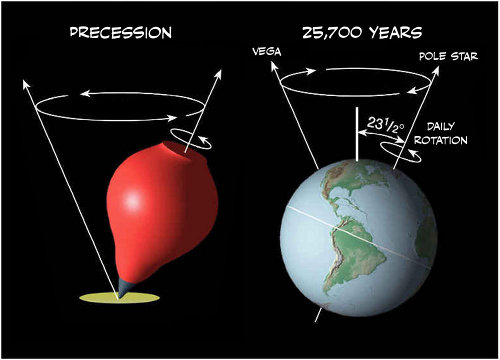
This article proposes the method in which the Star Calendar (S) implements the precession of the equinoxes. It is simple and elegant, yet extremely accurate, making it easy for anyone to know the small adjustments to apparent star positions which are necessary because of their very slow shifting. This article explains how the star day on the Spring Equinox holy day on the Enoch Calendar (E) remains unchanged during each "equinox star era" of either 455 or 546 years.
1. Precession
 |
 |
 |
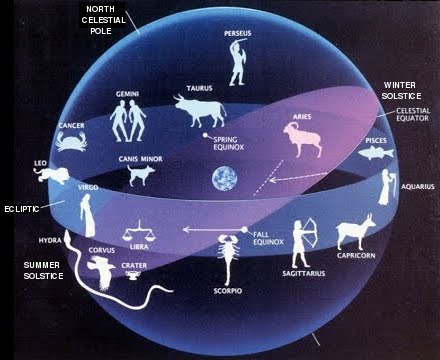
These seasonal Star Calendar feast days require access to two facts beyond simply looking at the stars. First, it requires knowing when the spring equinox occurs. Second, it requires determining when the equinox point precesses to a new star. The problem is to know how the Star Calendar determines those two entities. Calculating the spring equinoxes and star positions separately from the Enoch Calendar led to much confusion because the stars were being calculated by the position of the true equinox whereas the Spring Equinox (E) day varies from about 18 March to 31 March because it must always occur on a Saturday when the moon is not full.
The problem is best seen with the Star Calendar feast ages. It would seem best, for example, to have a clean break between the Feast Age of Taurus and that of Aries. In the earlier article, all that could be concluded was that the transition between those ages occurred somewhere around 600 BC. That shift, however, did not seem clear because for many years the equinox would shift between the Ram and the Bull. How were the ancients to know which age they were in? It would be so much simpler to have the exact transition year indicated on their calendar.
Let us now turn to a very simple solution, which God does indeed seem to be using.
2. Enoch Calendar Use
Let us now look at how the Enoch Calendar can be used to provide the needed information for the Star Calendar to indicate just which star day coincides with the spring equinox during any given year of history.
2.1 Enoch Equinox
The answer to the first problem of how to determine the date of the spring equinox is simply to use the Spring Equinox (E) holy day as the yearly definition of the date of the spring equinox. Even though it varies over a two week period from the true value, it does provide a definitive date. Remember that none of the sacred calendars studied in my work track the actual positions of celestial bodies but use a symbolic nearby representative date. Thus, let us consider using the Spring Equinox (E) date. It should not be surprising to use the Enoch Calendar because, after all, it was in the Book of Enoch that the Star Calendar was described. Thus, the two might well form a set to be used in tandem.
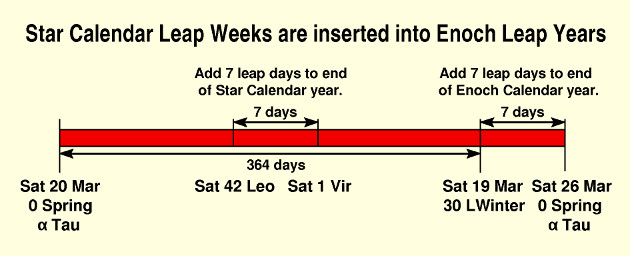 |
If nothing were done to adjust the Star Calendar, then the star α Tau would fall 364 days after the beginning of the graph, so its day would be Sat 19 Mar on the next year. Thus, to keep the equinox star date occurring on 0 Spring, it is necessary also to insert 7 days into the Star Calendar during that Enoch year. Those days must be added after the last day of the Star Calendar year, being 42 Leo. The illustration shows that week being inserted during the Enoch year (between June and October, slowing varying throughout history), which pushed the Star Calendar New Year Day (1 Vir) to be a week later. Accordingly, all of the star days thereafter are advanced one week, with the effect being that the star α Tau will occur on Sat 26 Mar and 0 Spring of the next Enoch year. Thus, the star α Tau remains the equinox star after both intercalations are completed.
2.2 Equinox Star Eras
Now consider the second problem of how to define a transition date between different spring equinox stars. We might expect that the star day could simply change to the next star every 72 years, but that is not allowed. Remember that, like the Enoch Calendar, the Star Calendar only inserts entire leap weeks at a time, not single days. Thus, changing what star is rising on the spring equinox requires waiting about 7 x 72 years, or about 504 years.
It is time to consider this problem more precisely in terms of inserting leap weeks to account for precession. There are exactly 52 weeks in an Enoch year. Shifting the equinox star by 52 weeks corresponds to one complete precession cycle of 25,772 years. How can that be done in a way easy to understand by using the Enoch Calendar?
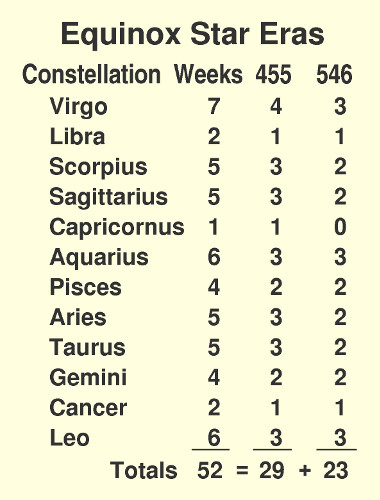 |
One final detail of the implementation is that during the year of changing spring equinox stars an extra leap week on the Star Calendar would be inserted at the end of that Star Calendar year. For that to be possible, it means that none of those transition years could already be a leap year on the Enoch Calendar. Each proposed year of transition was verified not to be a leap year year (E). Thus, the manner of adding the extra leap week is exactly as shown in Figure 4, with the difference that the Enoch year is not a leap year. Thus, in that figure, the day Sat 19 Mar would be the new 0 Spring day (Spring Equinox, E) and hence would no longer fall on the star day of Alpha Tau, but on the star one week earlier, in this case Alcyone in the Pleiades. That star would then reign for the next entire equinox star era.
3. Results
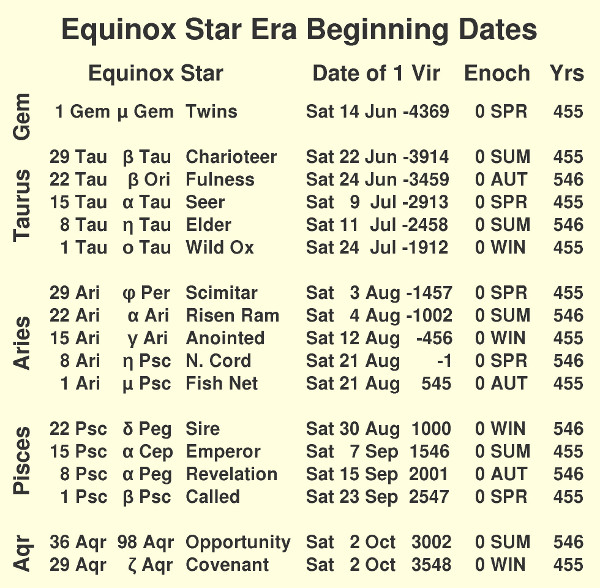 |
Further research might indicate whether or not these eras correlate to specific religious ages. For example, the Era of 15 Tau (α Tau) begins just after the translation of Enoch in 2948 BC and of the birth of Noah five years later. Then the next era begins shortly after the Deluge and includes the lives of the Abraham and Isaac. The following age begins with Jacob and lasts through the beginning of the Exodus. Then the next age begins during the 40 years in the wilderness after the Exodus, which truly seemed to mark a division between Israel's long sojourn in Egypt and the beginning of their existence as a nation in their promised land. The next era includes King David and Solomon's reign up through the exile of Israel and their return.
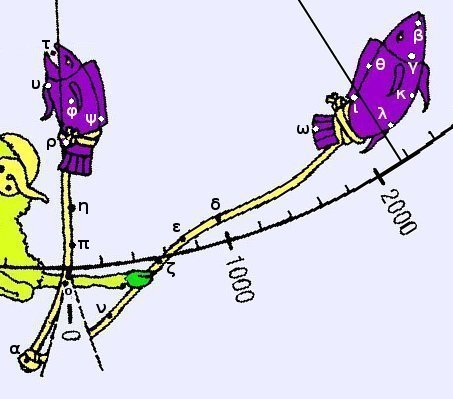 |
What about later eras? One began in 1546 which fits well with the entire period of the Reformation and Restoration, starting near the birth of Martin Luther and lasting all the way through the time of the Prophet Joseph Smith. Interestingly, a new era began just four days after the Twin Towers fell which indeed has been burned into everyone's memory so strongly that it indeed may have marked the beginning of the reign of the Anti-Christ, the destruction of the proud and wicked, the founding of Zion, return of the Enoch's city, and the Second Coming. Moreover, the following era ends almost exactly in AD 3000, marking the end of 7,000 years since mortality began. The last era will continue through the end of the "little season" thereafter.
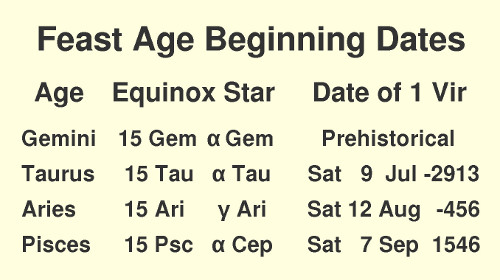 |
Now, by using Table 3, the precise transition day can be pinpointed. The Feast Age of Gemini lasted until Sat 9 Jul 2914 BC (-2913), which was the first time that the star on 15 Tau (Aldebaran, α Tau) would rise on the Spring Equinox (E). Before that day the equinox star was 22 Tau, meaning that 15 Tau had already risen before the equinox. For Passover (S) it must rise on or after the equinox (E), so 15 Tau could never before have been the Passover star. Table 3 similarly indicates that the Feast Age of Taurus ended in 457 BC and that of Aries ended in 1546. The Feast Age of Pisces will last until 15 Aqr is the equinox star, which will be after the Millennium.
These feast ages also require more investigation. There are probably many mysteries hidden in the dates of both the equinox star eras and also the feast ages.
4. Conclusion
A solution is proposed to explain exactly how the precession of the equinoxes can be handled by the Star Calendar simply and accurately. First, inserting leap weeks according to the Enoch Calendar can be used in nearly every year, making it possible for one single star day always to fall on the Spring Equinox (E) for the approximately five centuries when that one star is indeed near the spring equinox day. Then the adjustment needed after that period of time to the next star can be made during EQUINOX or SOLSTICE years on the Enoch Calendar, which occur every 91 years. The transition could take place after five or six periods (455 or 546 years), each called an "equinox star era", in a manner that all of those 52 ages would total to 25,753 years, extremely close to the true value of 25,772 years for the entire precession cycle. That way one star would reign over an entire equinox age and then transition smartly to a new age, both being associated with the Enoch Calendar.
Using this system noticeably improves the number of Star Calendar holy days occurring on the already proposed dates of several sacred events from history, indicating that this system might well be that used to witness of His works by the Creator!
Notes
- This accurate value of 25,772 years from the Encyclopedia Brittannica differs from the often quoted value of 25,920 years, which is the approximation used by the Hebrew Calendar and hitherto in my work. For example, the Hebrew day is divided into 25,920 "parts" (chalakim) instead of 86,400 seconds as in our Babylonian system of dividing hours into minutes and seconds. That value of 25,920 years comes out neatly to exactly 1° every 72 years and also 50" of arc per year. The true length of the precessional cycle is introduced in this article to emphasize the accuracy of equinox star eras.
- Pratt, John P., "Zodiac Feast Ages and Holy Days" (17 Mar 2019).
- The "twelve days of Christmas" tradition apparently goes back to when some early Christian Churches believed the Jesus was born 12 days after the spring equinox. At the time of Christ, the equinox was believed to occur on 25 March and 12 days later was 6 April. St. Augustine changed it so that Christ was born on 6 January, 12 days after the winter solstice on 25 December. When the Catholic Church divided, the Roman version held Christmas on 25 December, but the Eastern Church held to Jesus being born on 6 January. Later, to reconcile the two, the Eastern Orthodox Church changed to celebrate 25 December as Christmas and 6 January as Epiphany, the date of the visit of the magi 2 years later. The reason the 12 number shows up again now is that in that year of Christ's birth the Spring Equinox (E) was on Sat 25 Mar 1 BC (G) (i.e. on 25 March like the tradition).
- Pratt, John P., "Zodiac Feast Ages and Holy Days" (17 Mar 2019) Section 2: Feast Star Days.
- Pratt, John P., "Celestial Witnesses of Christ Breaking the Bands of Death", Meridian Magazine (26 Apr 2001), Section 3: Cutting the Bands of Death.