Circle of Seven Pole Stars
by John P. Pratt
14 Feb 2018, 1 Birth (V), 1 Wind (SR)
©2018 by John P. Pratt. All rights Reserved.
A circle of seven successive north pole stars is identified which take turns being the North Star over a 26,000 year cycle.
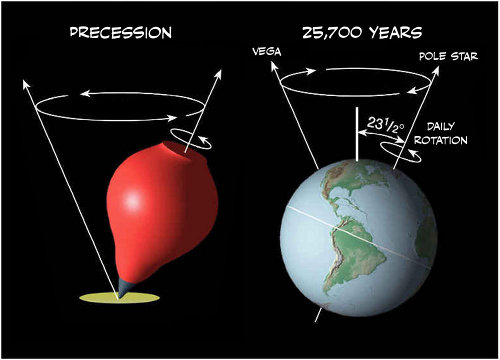 |
Of late it has been noted that the ancients were not only aware of the slow precession[2] but also of a series of seven pole stars which would each successively become the North Star over the 26,000 cycle. When a new North Star began to reign it was said to be a "new heaven".[3] This article attempts to identify those seven stars using criteria of nearness to the circle traced out by the earth's axis, brightness, and roughly even spacing between those proposed pole stars.
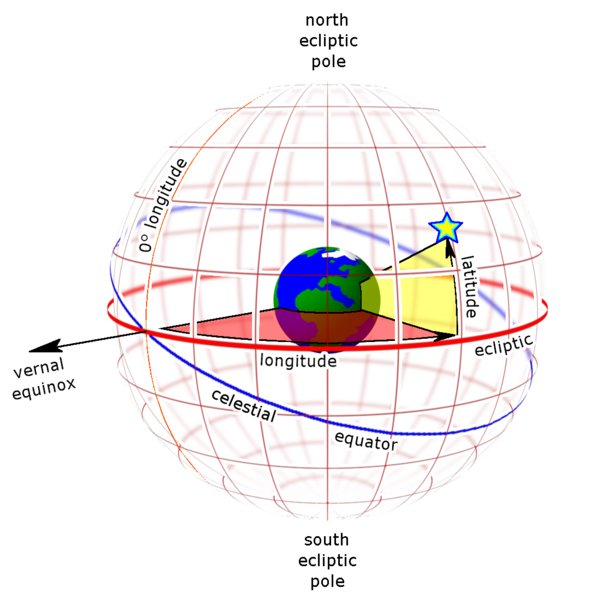 |
To find the list of candidates, it was determined that the star should be found among the original constellations and be brighter than magnitude 4.0. Small magnitudes mean brighter stars. The star Vega (α Lyr) has magnitude 0.0 and is one of the two brightest stars in the northern sky. My Restored Constellation Star Catalog[5] was sorted on celestial latitude. Because the axis of the earth is tilted 23.5° to the ecliptic, stars were sought with latitude 66.5°, being 90° minus 23.5°, which would define the pole star circle path that is shown in Figure 1.
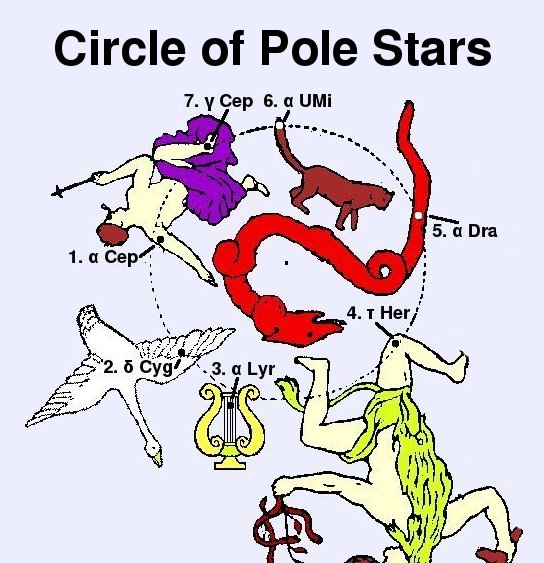 |
There are only six constellations which include part of the circle of pole stars, so one of them needs to contain two of the stars. It turned out that Cepheus, the King, has two well spaced stars. Moreover, it was noticed that in all the Lord has created the first is the last and the last is the first (D&C 29:30). Thus, it seems appropriate to number them such that the first and last are both in the King. As a witness that that numbering is correct, it was noticed that the last star of the zodiac is υ Leo, in the foot of the King of Beasts, Leo the Lion. Similarly, the seventh star in the circle is in the foot of the King.
The seven stars are shown in Figure 3, which shows the circle of 23.5° radius centered on the north ecliptic pole, which circle defines the perfect pole star positions. Our current pole star Polaris is shown as number 6 and is one of the nearest to the actual circle. The last accurate North Star was Thuban (α Dra) in the Dragon, thought to be the star used to align the Great Pyramid of Giza in ancient Egypt to true north while it was being built. Nearly opposite of Polaris in the circle is Vega (α Lyr) in the Lyre, one of the brightest stars in the sky.
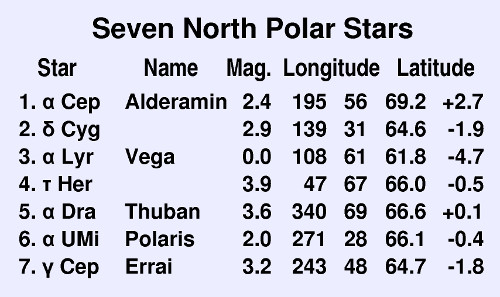 |
Thus it is seen that we are in the season of the sixth pole star Polaris. The exact time of changing to the beginning of the seventh season of the King is not yet understood, but we'll likely be in the current season all during the coming Millennium. At the end of that time the scriptures say there will be "a new heaven and a new earth" (Rev. 21:1), so it could be at that time that the earth will enter the dominion of the North Star of the King.
Notes
- Pratt, John P., "Zodiac Ages and Their Presidencies" (29 Apr 2017), Section 1.1: Precession of Equinoxes.
- See de Santillana, Georgio, & von Dechend, Hertha, Hamlet's Mill (Boston: Gambit, 1969). The book "is mostly about the claim of a Megalithic era discovery of axial precession, and the encoding of this knowledge in mythology" (quoting wikipedia article).
- One interpreter of scripture opined: "When the pole star changes, which happens about seven times every 25,900 years, anciently that change was called 'A New Heaven'." On the other hand, he suggested that "new earth" refers to a new zodiac age (see article referenced in footnote 1). See Snuffer, Denver, "Third Address to Christians", (Atlanta, Georgia, 16 Nov 2017), Q&A Section.
- Traditional celestial longitude is measured from the point of the vernal equinox on the ecliptic. In this article "longitude" refers to sidereal longitude which is measured from the star π Virginis as the zero point.
- Pratt, John P., "Restored Constellation Star Catalog" (22 Jun 2017).