The Scorpion Metes Out Justice With His Balance
by John P. Pratt
4 Feb 2016 (1 Light)
©2016 by John P. Pratt. All rights Reserved.
| 1. The Balance |
| 2. The Scorpion |
| 3. Conclusion |
| Notes |
Recent articles have attempted to restore some of the constellation figures to their original form, hopefully to that revealed to the prophet Enoch long before the ancient Greeks who are our principal source of knowledge of the figures.[1] The key to restoring the originals was the discovery that the stars listed in the ancient Greek astronomer Ptolemy's star catalog which are identified as stars between constellations are often stars which were formerly included in the constellations but had been removed by an astronomer who felt he could draw the figure better.[2] This article discusses a proposed restoration of the adjacent zodiac constellations of the Scorpion (Scorpius) and the Balance (Libra) to a more ancient form, which is achieved by utilizing those formerly deleted stars.
1. The Balance
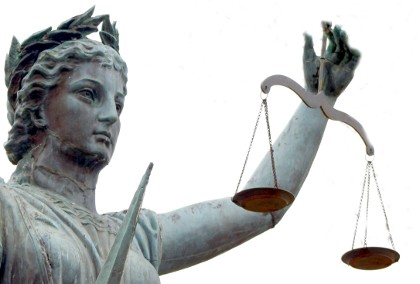 |
The Balance is usually believed to be a constellation invented by the Romans because it was apparently not known to the Greeks who preceded them. In its place in front of the Scorpion the Greeks saw only the great claws of the Scorpion. One big clue that they had known earlier that something else was there was the fact that they referred to the Claws as a separate constellation from the Scorpion. While the constellation of the Balance was unknown to Aratus and Greeks later than 350 BC, it was apparently known to Homer in about 850 BC. He wrote, "The Eternal Father hung his golden scales aloft."[3] Many ancient references to the Balance refer to them as being "golden" and they are colored yellow in my illustrations.
Additional research shows that in fact the Balance is an ancient constellation known much earlier. Manetho, writing during the 3rd century BC, is one of our principal sources for our knowledge of ancient Egypt. He claimed that the Egyptians invented the constellation of the Balance.[4] It is shown in several Egyptian temples, such as the planisphere at the temple of Hathor at Dendera, Egypt and also the temple of Khnum at Esna, Egypt. Both temples are believed to have been constructed one or two centuries BC, but the zodiac of Dendera can be dated to many centuries earlier.[5] That is, the zodiac drawing was apparently copied from a much earlier star map.
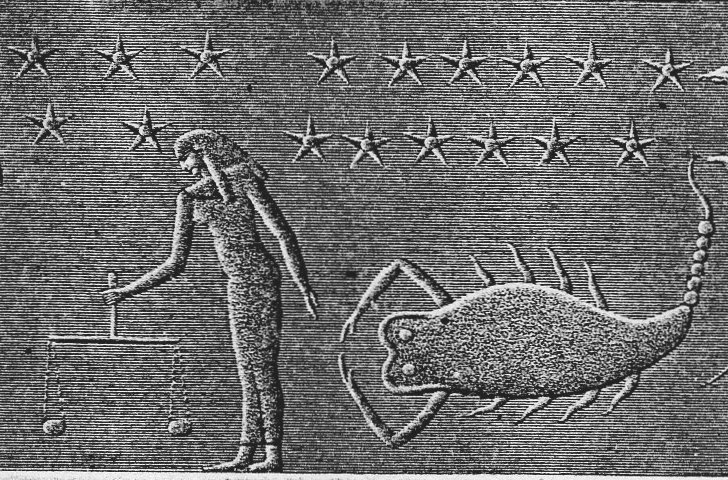 |
The constellation of the Balance was also known to the ancient Persians. Figure 2 shows an illustration from a 1475 edition of the works of Albumazar based on the ancient Persian description of the constellation.[7] Note that both of these figures show a hand-held balance with a solid handle. One secular scholar notes that "the Persian sphere shows a human figure lifting the Scales in one hand and grasping a lamb in the other."[8]
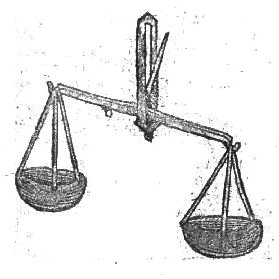 |
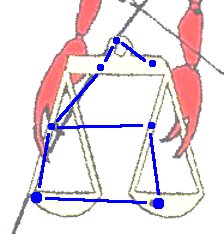
This method yields results good enough to provide the confidence to publish this paper. The most easily recognized part of the constellation of the Balance is formed by 4 stars roughly in a square shape. Two are bright and two dimmer. The main question is what are the other stars and how is the figure shaped. Of the nine extraneous stars listed, three are between the Claws and six outside of them. If the three between the claws are added to the four that are almost certainly in the Balance, they form a figure almost identical to an ancient hand balance scale as we saw in Figures 1 and 2. Figure 3 shows the proposed restoration of the Balance, with the three restored stars indicated in the handle. Note that all three fall almost exactly along the ecliptic, which is the apparent path of the sun and planets through the heavens. The angle of the handle to the beam indicates that the Balance has one tray lower than the other as often shown in ancient drawings, such as that of Albumazar shown in Figure 2. In fact, even the lengths of the suspension straps, sizes and shapes of trays are very similar. When the proposed restoration figure was drawn, all of those details were dictated by the star positions.
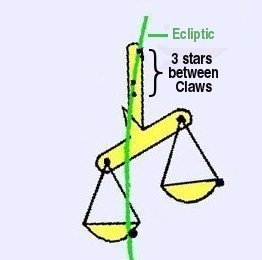 |
This discovery seems important enough to assign new names to these two bright stars. In the Arabic both stars were referred to as trays, but the brighter star (on the ecliptic) is also called "the Weight", most likely referring to it being the lower of the two trays. In my future work, the ecliptic tray star, Alpha (α) Lib, will be called "Wazn", meaning "Weight" in Arabic. The other tray star Beta (β) Lib will be called "Kiffah", being Arabic for "Tray". Both are part of their Arabic names.
 |
2. The Scorpion
Now let us apply the same process to the Scorpion. Let us see if we can utilize the stars listed as outside of the Claws to incorporate into a scorpion image which is plausible and does not confuse the two figures. Figure 5 illustrates my best guess at the correct version of the constellations before the new version being proposed in this article. It illustrates five of the six stars which Ptolemy lists as outside the claws. The sixth is located well above the left claw and does not appear to be usable.
 |
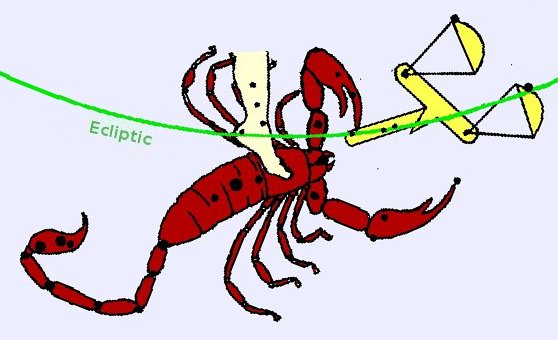 |
If that is indeed the original form of the Scorpion, it is easy to see how astronomers might change the stars forming the scorpion to be in a more natural position. Probably the first step was to put the Balance between the claws, which is how I have it shown in my earlier articles. The problem with that was that there were no stars in the claws that clearly showed their position. The next step would be to get rid of the Balance altogether because it didn't fit the pattern of the other constellations. It was the only non-living figure. So the claws were made even larger for the Greeks and the Balance disappeared.
 |
Why would the Scorpion be figured holding the Balance? In earlier articles it was proposed that the Scorpion has at least dual symbolism. On the one hand (left hand), it represents Satan, who is being crushed by the Serpent Bearer. On the other hand (right hand), it represents Christ as the Judge.[11] Scripturally a scorpion is a type of serpent and Christ was often represented by a serpent, such as the serpent which Moses raised on the staff.[12]
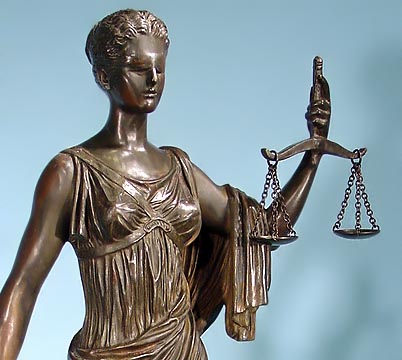 |
The balance being used to judge mankind is also a scriptural image. As the writing on the wall read by Daniel said of the king, "Thou art weighed in the balances, and art found wanting." (Dan. 5:27). May that not be said of us on Judgment Day.
Following the lead of many earlier researchers, it has been proposed in my articles that Libra symbolized the role of Christ as the Redeemer who would pay the price of redeeming the souls of mankind. In that symbolism, the Balance is not shown balanced but instead with the side representing Christ's payment as lower, having more than paid the price of all sin. As seen from the Scorpion's point of view, Christ is on the right side and mankind who is found wanting is on the left. The concept also fits well with the Persian version where the person holding the scales is also holding a lamb, which could represent the Lamb of God who paid the price.
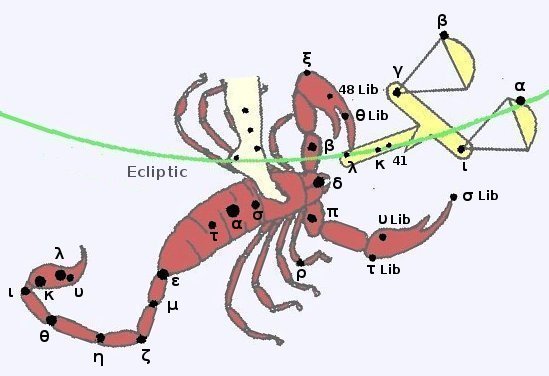 |
The modern designations of the five stars added to the Scorpion are Xi (ξ) Sco, 48 Lib, Sigma (σ) Lib, Tau (τ) Lib, and Upsilon (υ) Lib. Note that the star Lambda (λ) Lib is to be considered as being shared both as the tip of the left claw of the Scorpion and also the end of the handle of the Balance. Many stars are found in two constellations as it often helps to show the relationship between them. In this case, from a simple list of stars and their positions in the figures, such as that given by Ptolemy, it would be clear that the Scorpion is holding the Balance.
3. Conclusion
Earlier papers showed that the key to restoring ancient constellations to their original form is often found in utilizing stars which are listed in Ptolemy's star catalog as being near but not included in the figure. The Balance (Libra) was entirely lost to the Greeks who only saw the Claws of the Scorpion in that place. Using eight of the nine stars listed as near the Claws, the proposed restorations of both the Balance and the Scorpion are presented. The form of the Balance matches ancient depictions of a hand-held balance. Moreover, utilization of the stars near the Scorpion implies that his left claw is holding the Balance. Earlier papers identified one interpretation of the Scorpion as Christ in his role as Judge, so this restoration with Him meting out justice with a balance becomes yet another witness to the constellations typifying the gospel and mission of the Savior Jesus Christ.
Notes
- Pratt, John P., "The Forgotten Left Stream of Aquarius" (9 Jan 2016) summarizes the ideas and sources and attempts to restore the missing left stream of the constellation of the Water Bearer (Aquarius).